50+ Free Cover Letter Examples for Every Industry
Discover professional cover letter examples for every industry and career stage. Every example in this guide is ATS-optimised, annotated with a breakdown of what makes it work, and accompanied by industry-specific advice so you can adapt it to your own application in under fifteen minutes.
Quick answer
The best cover letter examples are specific to the role and company, use keywords from the job description, and stay within 280–350 words on one page. Adapt any example using the 5-step process in this guide.
What you will learn
- What separates a great cover letter example from a generic template
- Industry-specific advice for Tech, Finance, Healthcare, Creative, Marketing, and Graduate roles
- A 5-step process for adapting any example to your specific application
- The dos and donts of cover letter adaptation that most candidates miss
Cover letter examples by company
Build your cover letter in minutes
Free to start. Tailored drafts from your resume and the job description. No credit card required.
Why Cover Letter Examples Still Convert
Cover letter examples are not just templates to copy. They are teaching tools. When you study a strong example closely you start to understand what recruiters are actually looking for: a clear opening hook, concrete evidence of relevant achievement, and a closing that creates momentum toward an interview. The 85 per cent read rate tells us that cover letters remain a primary decision-making input for hiring managers across sectors.
The 3x interview rate uplift from well-written cover letters is a consistent finding across recruitment studies. The reason is straightforward. Most candidates send generic applications. A letter that names the company, reflects the role language, and connects one specific achievement to one specific requirement immediately stands out. The examples in this guide are built around that principle. They are starting points, not finished products.
The 94 per cent ATS parse rate refers to structured plain-text or simple-format letters. Heavily designed cover letters with complex layouts, tables, or graphics often fail ATS parsing and never reach a human reviewer. All four templates in this guide use clean text hierarchies that parse reliably across major ATS platforms including Workday, Greenhouse, SAP SuccessFactors, and SmartRecruiters.
What Separates Great Letters from Generic
Specificity Over Generality
The strongest cover letters reference the company by name, cite a specific role requirement, and connect it to a concrete personal achievement. Generic statements like "I am a team player" are meaningless. "I coordinated a six-person cross-functional team to deliver a product launch three weeks ahead of schedule" is not.
Tone Matching
A great example letter sounds like it was written by someone who has actually read the company website. The tone of your letter should reflect the culture of the employer. A law firm and a gaming startup have very different expectations. Matching tone signals cultural awareness and saves the recruiter from imagining a poor fit.
Keyword Alignment
The best examples mirror the exact language of the job description. ATS platforms compare your letter against the posting and score it for keyword density. Human recruiters also notice when you use the same terminology they do. Using "stakeholder management" when the posting uses that phrase is not mimicry. It is speaking the employer's language.
Length Discipline
A strong example never exceeds one page and most land around 280 to 350 words. Every sentence earns its place. If a sentence does not tell the recruiter something new about why you are the right person for this role then it should be cut. Brevity is not laziness. In a cover letter it is the highest form of respect for the reader's time.
Professional Cover Letter Templates
Each example below is ATS-optimised and comes with a breakdown of what makes it work and guidance on which roles and industries it suits best. Use these as your starting point and follow the adaptation guide further down this page to make each one genuinely your own.
1. Professional Pitch Cover Letter
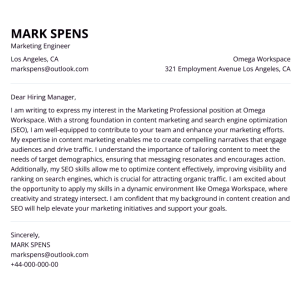
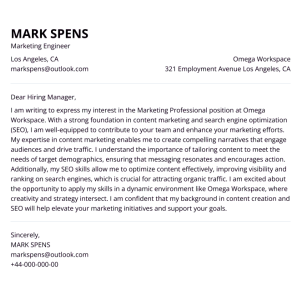
Best for tech, SaaS, fintech, and digital agency roles at any seniority level.This template is built for candidates applying to technology-related roles or modern industries such as software development, IT, and digital marketing. The clean layout presents your qualifications in a structured and visually accessible way that makes it easy for recruiters to scan your application quickly. Whether you are a seasoned professional or entering the workforce for the first time, this format helps you present your experience, skills, and enthusiasm concisely. The body of the letter is structured to demonstrate your alignment with the role requirements and your enthusiasm for the organisation. ATS platforms parse this format reliably because the content hierarchy is clear and the keywords sit in predictable positions.
Key Features
- Opens with a clear professional reference to the exact job position ensuring immediate relevance.
- Contact details are prominently placed at the top for fast recruiter access.
- Content flows logically from introduction through achievement to closing call to action.
- Designed with modern ATS requirements in mind so essential keywords are in prominent positions.
2. Modern Blue Cover Letter
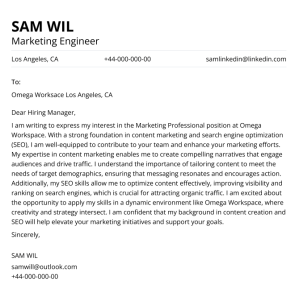
Best for marketing, design, creative agencies, and product roles where visual polish matters.The Modern Blue Professional template uses bold accents and a clean layout designed to make an immediate visual impact while remaining fully ATS-compatible. It highlights your contact information and position title prominently so your key details stand out from the supporting content around them. The template is an excellent choice for candidates in tech, marketing, and creative industries where a degree of visual personality is expected and welcomed by employers. The structure guides the recruiter through your qualifications while maintaining a balance between creativity and professionalism that works across both startups and established corporations. Every section is labelled clearly so the reader never has to hunt for information.
Key Features
- Focus on simplicity ensures all essential information is accessible without visual clutter.
- Ideal for tech, marketing, design, and creative roles but easily adapted to other sectors.
- The recipient section reflects professionalism and demonstrates attention to detail.
- Bold accent colour draws the eye to the most important elements without overwhelming the content.
3. Classic Elegant Cover Letter
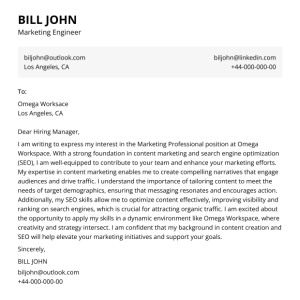
Best for finance, legal, consulting, public sector, and traditional corporate roles.This template uses a traditional layout with subtle professional styling that is particularly well suited to finance, law, consulting, and administrative roles where clarity, structure, and conservative presentation are expected. The restrained design signals professionalism and reliability before the recruiter has read a single word. The body of the letter focuses entirely on professional experience and achievement with no visual distractions. Every formatting choice in this template has been made to maximise readability for both human reviewers and ATS systems. Recruiters in formal sectors have been using this structure for decades because it works: it is easy to scan, easy to parse, and easy to evaluate against a set of requirements.
Key Features
- Traditional design and structure works perfectly for formal and regulated industry applications.
- Professional greeting and clear formatting for name and contact details convey seriousness.
- Body copy focuses entirely on professional experience with no distraction from the core message.
- Conservative colour palette and typography signals reliability and attention to convention.
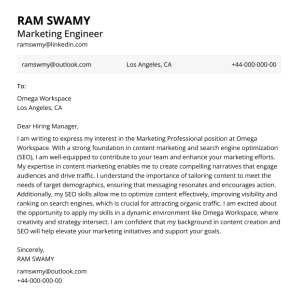
4. Modern Minimalist Cover Letter
Best for startups, tech companies, UX roles, and any employer with a minimalist brand aesthetic.This sleek minimalist design is tailored specifically for modern industries including startups, tech companies, and creative studios where clean and uncluttered presentation is a cultural signal as much as a practical choice. The absence of decorative elements ensures the recruiter focuses entirely on your content rather than the container around it. Clear section separation and generous whitespace make the letter easy to read at speed which matters in high-volume hiring environments. ATS systems parse this format reliably because there is no complex graphical structure to confuse the text extraction process. This is the go-to template for candidates who want their words to do all the work.
Key Features
- Clean and sleek design directs all recruiter attention toward the content itself.
- Minimal visual distraction is ideal for tech and creative industries with high application volumes.
- Modern layout with clear section separation makes scanning fast and effortless.
- Reliable ATS parsing because no complex graphical structure interferes with text extraction.
Industry-Specific Guidance That Works
Different industries have different expectations for cover letters. The same content strategy that works brilliantly for a software engineering role can look jarring in a finance or healthcare application. Use this section to understand what tone, structure, and evidence type works best for your specific sector.
Technology
Tech cover letters should lead with your most relevant technical skills and mention specific languages, frameworks, or platforms that appear in the job description. Quantify your impact wherever possible. "Reduced API response time by 40 per cent" means far more than "improved performance." Keep the tone professional but direct and avoid corporate filler phrases. Recruiters at tech companies read dozens of letters per day and reward clarity above all else.
Finance
Finance cover letters should be formal, precise, and achievement-driven. Cite specific financial metrics you have worked with, regulatory frameworks you understand, and any relevant qualifications such as CFA, ACA, or ACCA. Avoid casualness. Employers in this sector interpret a loose tone as a signal about how you handle compliance and detail. Structure the letter conventionally and let your track record speak without embellishment.
Healthcare
Healthcare cover letters should emphasise patient care experience, relevant clinical or administrative qualifications, and your understanding of the regulatory environment. Highlight soft skills like empathy, communication under pressure, and the ability to work in multidisciplinary teams because these matter as much as clinical knowledge to most hiring panels. Align your letter with the organisation values framework if applying to the public sector.
Creative
Creative cover letters have more room for personality but should still be structured and purposeful. Lead with one stand-out piece of work or a brief description of your creative approach. Link to your portfolio early so the recruiter can view your work while reading. The letter itself is part of the creative audition so write with care and let your voice come through without sacrificing clarity.
Marketing
Marketing cover letters should demonstrate that you understand the employer's audience, brand voice, and current campaigns. Reference a specific piece of their content or a campaign result that impressed you. Quantify your own results where possible because marketers are expected to think in terms of data. Use the letter to show that you can craft a compelling message, because that is exactly what the job requires.
Graduate
Graduate cover letters succeed when they replace experience with evidence of potential. Anchor academic projects, placements, and extracurricular activities to specific skills listed in the job description. Graduate employers consistently say they value initiative, problem solving, and communication over raw academic grades. Explain what you learned and how you applied it rather than simply listing what you studied.
How to Adapt Faster for Interviews
A cover letter example is only valuable if you personalise it. Follow this five-step process every time you adapt an example for a new application. It takes around fifteen minutes once you have your master letter ready and it is the single most effective way to increase your interview rate.
Read the job description twice
On the first read absorb the overall picture. On the second read highlight every repeated skill, tool, qualification, and phrase. These repetitions are the employer's priority list.
Extract three to five keywords
Write the most important phrases in a separate note. These will go directly into your adapted letter using the exact wording from the posting rather than synonyms.
Swap in your matching achievements
For each keyword find a concrete example from your own history. Replace the generic achievement in the example letter with your specific quantified result.
Set the tone to match the company
Read the company's careers page and one or two recent social media posts. Adjust your language to match whether the culture is formal, conversational, or somewhere in between.
Run the final check
Confirm the company name is correct, the job title matches the posting exactly, the file is saved as a PDF, and there are no leftover placeholder references from the original example.
Dos and Donts That Matter
What to DO
- Always replace the generic example achievement with a real result from your own history.
- Update the opening hook for each application so it references the specific role and company.
- Use the exact keywords from the job description rather than synonyms the ATS might miss.
- Match the tone to the employer culture by reading their careers page before adapting.
- Keep the total length between 280 and 350 words after adaptation.
- Save the adapted letter as a PDF with a professional filename including your name and the role.
What to AVOID
- Do not leave any placeholder text from the original example such as [Company Name] unreplaced.
- Avoid sending an adapted letter without re-reading it aloud to catch awkward phrasing.
- Do not keep achievement examples that are irrelevant to the role even if they sound impressive.
- Avoid adapting the format or visual style for roles where that style does not fit the industry.
- Do not use the same opening sentence for every application even with small word changes.
- Avoid over-adapting to the point where the letter loses your authentic voice and personality.
The most common adaptation mistake is changing only the company name and job title while leaving everything else identical to the example. Recruiters at popular employers see hundreds of letters built on the same templates. What makes yours stand out is not the structure but the specific evidence you put inside it. Two concrete achievements tailored to the role will always outperform ten generic claims dressed up in a professional format.
Frequently Asked Questions
Start by looking at the formality level of the role and company. Traditional sectors like finance, law, and public institutions expect a classic formal layout while tech startups and creative agencies respond better to modern or minimalist formats. Read the job description and the careers page to gauge tone and then pick the example that most closely matches that energy. When in doubt, go slightly more formal rather than less.
You can use the same example as a structural base but you must customise the content for every single application. Change the greeting, the opening hook that names the role and company, and at least two concrete achievement examples to match the specific job description. Recruiters can immediately spot a generic letter and it signals that you are not genuinely interested in their particular role.
Aim for 280 to 350 words across three to four paragraphs. Every example in this guide follows that constraint. Shorter letters tend to feel rushed and under-evidenced while longer letters waste the recruiter's time. The goal is one punchy page where every sentence adds something new about why you are the right person for this specific role.
Ideally yes. A matching design signals professionalism and attention to detail and makes a stronger first impression when both documents are viewed side by side. NeuraCV's builder automatically generates a cover letter that matches your CV template so the two documents form a coherent professional set without any manual design work.
Replace the work achievement sections in the example with evidence from university projects, volunteer work, placements, personal projects, or online certifications. Graduate employers look for problem solving, initiative, and communication skills rather than years of paid experience. Connect every item you mention directly to a skill listed in the job description so the relevance is clear.
Yes. Modern ATS platforms used by employers globally parse cover letter text for keyword density and semantic relevance alongside the CV. Use the exact terminology from the job description in your letter rather than synonyms. Structured layouts with clear text blocks like the examples in this guide parse more reliably than heavily designed formats with tables or columns.
They are the same document. In many regions, "covering letter" and "cover letter" are used interchangeably. The term "cover letter" is now more common in digital hiring contexts, while "covering letter" still appears in traditional sectors. Either term is widely understood by recruiters.
Remove any decorative elements, switch to a traditional serif or clean sans-serif font, and adopt a more formal tone throughout. Replace personality-driven opening lines with achievement-focused statements. Keep all the structural elements like header, greeting, hook, achievement paragraph, and sign-off but strip back the stylistic flourishes. The content principles remain the same even when the presentation changes significantly.
Build Your Cover Letter in Minutes
Free to start. No credit card required. Trusted by 50,000 plus job seekers.

About the Author: Sreerag M
Sreerag is a Career Tech Expert with over 10 years of experience reviewing cover letters and CVs. He leads content strategy at NeuraCV and has helped thousands of job seekers land interviews with targeted applications.
Meet our experts