Cybersecurity Threat Hunter Resume Guide
Threat Hunter resumes must quantify detections, MITRE ATT&CK framework coverage, and dwell-time reduction. A clean ATS layout with SIEM, EDR, and threat-intelligence keywords is non-negotiable. NeuraCV formats your adversary pursuit experience to pass enterprise security ATS filters and land roles in 2026.
01Executive Professional Summary for Cybersecurity Threat Hunter
Your professional summary is the first thing recruiters and hiring managers read. For Cybersecurity Threat Hunter roles, it must immediately signal depth: years of experience, core focus, and at least one concrete outcome. Anchor your opening around role signals such as mitre-aligned hunting, siem and edr depth, detection engineering, incident-response collaboration. Keep it to 2–4 lines and include one measurable proof point (dwell-time impact, coverage impact, false-positive reduction, containment-speed impact) so the summary works for both ATS matching and human scanning.
02Technical Philosophy & What Hiring Managers Value
Hiring managers in Tech care about impact, clarity, and evidence of ownership. Threat hunting hiring in 2026 rewards analysts who can turn proactive hypotheses into measurable detection coverage and enterprise risk reduction. Frame your bullets around quantified outcomes, clear responsibility, and operational context so the reader can quickly understand your scope and reliability.
03Deep-Dive Core Competencies
Name the tools, frameworks, and methodologies you use. Mirror job-posting language so ATS systems and recruiters can map your profile quickly. For Cybersecurity Threat Hunter, prioritize terms like mitre-aligned hunting, siem and edr depth, detection engineering, incident-response collaboration, then back each cluster with one short result-oriented example linked to dwell-time impact, coverage impact, false-positive reduction, containment-speed impact.
04How to Structure Your Career Narrative on Your Resume
Use a reverse-chronological experience section. For each role, lead with scope and then 3–5 bullets in context-action-result format. Show progression over time and make sure each role demonstrates at least one concrete operational proof point (dwell-time impact, coverage impact, false-positive reduction, containment-speed impact) tied to the realities of Cybersecurity Threat Hunter.
05Featured Case Studies: Problem–Solution–Impact
Use a Projects or Key Projects section to highlight 2–3 major initiatives in a Problem-Solution-Impact format. Each entry should state the challenge, your approach, and a measurable outcome. For Cybersecurity Threat Hunter, projects should reference role signals (mitre-aligned hunting, siem and edr depth, detection engineering, incident-response collaboration) and close with measurable impact (dwell-time impact, coverage impact, false-positive reduction, containment-speed impact).
06Mentorship, Leadership & Continuous Learning
Mentorship, process ownership, and continuous learning show leadership and reliability. One concise bullet per role is enough, but it should be specific to Tech workflows and show contribution beyond task execution. Where relevant, include coaching, SOP improvements, or cross-team handoff standards.
07Continuous Learning & Certifications
Relevant certifications help with both ATS and recruiter screening. List certification names, validity, and recency, then connect them to real execution in your bullets. Keep this section tight (2–5 items) and prioritize credentials that reinforce role signals such as mitre-aligned hunting, siem and edr depth, detection engineering, incident-response collaboration.
08FAQ: Technical Expertise
Common recruiter questions include resume length, role-specific keyword coverage, and how to prove impact without inflated titles. Use the FAQ section below for detailed answers tailored to Cybersecurity Threat Hunter hiring in 2026, with examples aligned to measurable proof points such as dwell-time impact, coverage impact, false-positive reduction, containment-speed impact.
Core Cybersecurity Threat Hunter Skills & Keyword Optimization
Use these keywords in your bullets and skills section. The example below shows how they appear in a real Cybersecurity Threat Hunter resume.
Recommended Keywords for ATS
Top Skills in Example
What the Numbers Say About Cybersecurity Threat Hunter Hiring
Why Do Cybersecurity Threat Hunter Resumes Get Rejected by ATS?
If you are applying for Cybersecurity Threat Hunter roles, your resume has to pass the ATS first. Here is what usually goes wrong:
No MITRE ATT&CK technique mapping
Threat Hunters who do not reference ATT&CK technique IDs (e.g., T1059, T1071) fail to demonstrate framework proficiency. ATS systems at enterprise security orgs scan for these explicitly.
Missing SIEM and EDR platform names
Generic 'security monitoring' is invisible to ATS. Name every platform: Splunk (with SPL queries), Microsoft Sentinel, CrowdStrike Falcon, SentinelOne, Elastic SIEM. Tool specificity signals operational experience.
No dwell-time or detection metrics
Hiring managers want evidence of hunting impact: dwell time reduced from X to Y days, X novel TTPs identified, or detection coverage increased by Z%. Without metrics, your experience reads as passive monitoring.
No threat-hunt lifecycle and reporting rigor
Senior hunting roles expect hypothesis design, hunt-to-detection conversion, and repeatable reporting workflows. Include end-to-end hunt process outcomes.
How NeuraCV Helps Cybersecurity Threat Hunters Land More Interviews
NeuraCV matches your threat intelligence and behavioral analytics experience against live 2026 security job descriptions, surfacing the exact MITRE ATT&CK techniques and tool names you need to include.
The AI ensures your certifications — OSCP, GCTI, GCIA — are formatted exactly as corporate security ATS filters expect, with correct acronym expansion and credential body names.
NeuraCV translates your AI-driven threat detection experience into structured resume bullets that demonstrate both analytical depth and tool proficiency to security engineering managers.
Role-specific prompts improve how you communicate detection engineering, hunt methodology, and incident-learning outcomes.
Guided phrasing helps link ATT&CK coverage and SIEM/EDR improvements to measurable risk reduction.
The NeuraCredits Advantage
Stop paying $25/mo subscriptions.
Use NeuraCredits for a simple one-time payment. Pay only when you generate a winning resume. No hidden recurring fees. Only pay for what you use.
NeuraCV vs. Typical Resume Builders
| Feature | NeuraCV | Typical Builders |
|---|---|---|
| Role-Specific Keywords | Hyper-specific to Cybersecurity Threat Hunter (e.g. exact tools & frameworks) | Generic categories only |
| Real-Time Job Tailoring | Dynamic contextual matching per JD | Static pre-written phrases |
| ATS Compatibility Check | Live scan with score | Not included |
| Pricing Model | Pay-per-use (NeuraCredits) | $25/mo subscription |
Role-Specific Keywords
- NeuraCV
- Hyper-specific to Cybersecurity Threat Hunter (e.g. exact tools & frameworks)
- Typical Builders
- Generic categories only
Real-Time Job Tailoring
- NeuraCV
- Dynamic contextual matching per JD
- Typical Builders
- Static pre-written phrases
ATS Compatibility Check
- NeuraCV
- Live scan with score
- Typical Builders
- Not included
Pricing Model
- NeuraCV
- Pay-per-use (NeuraCredits)
- Typical Builders
- $25/mo subscription
Frequently Asked Questions: Cybersecurity Threat Hunter Resume
What certifications should a Threat Hunter list on their resume?
+
The highest-value certifications for Threat Hunters in 2026 are: GIAC Certified Threat Intelligence Analyst (GCTI), GIAC Certified Intrusion Analyst (GCIA), OSCP (Offensive Security Certified Professional), Certified Threat Hunting Professional (CTHP), and CompTIA CySA+. For enterprise roles, list Microsoft SC-200 and Splunk Core Certified User/Admin. Place certifications in a dedicated section with the issuing body and expiration date.
How do I show dwell-time reduction metrics on a Threat Hunter resume?
+
Frame your hunting outcomes as before/after metrics: 'Reduced average adversary dwell time from 21 days to 4 days through hypothesis-driven threat hunting across 45,000-endpoint environment.' If you do not have exact dwell-time figures, use detection coverage expansion: 'Developed 18 new MITRE ATT&CK-aligned detection rules, increasing tactic coverage from 34% to 61% in Splunk SIEM.' Both formats are ATS-scannable and recruiter-memorable.
What SIEM and EDR tools are most in-demand for Threat Hunters in 2026?
+
The most frequently required tools in 2026 Threat Hunter job postings are: Splunk Enterprise Security (with SPL proficiency), Microsoft Sentinel (KQL queries), CrowdStrike Falcon (Threat Graph), SentinelOne, Elastic SIEM, Palo Alto Cortex XDR, and Recorded Future for threat intelligence. List every tool you have used operationally, including the specific capabilities you leveraged (e.g., 'Splunk ES correlation search authoring').
Should I include CTF or bug bounty experience on a Threat Hunter resume?
+
Yes, especially for candidates with under 5 years of professional experience. List your top 2–3 CTF results with platform (HTB, TryHackMe), challenge type, and your ranking or score. For bug bounties, include the program name, vulnerability class, severity level, and CVE if assigned. These demonstrate active offensive mindset — a quality that separates proactive hunters from passive analysts.
How long should a Cybersecurity Threat Hunter resume be?
+
One page for analysts with under 6 years of experience. Two pages are appropriate for senior hunters or threat intelligence leads with multi-environment hunting programs, published research, or speaking engagements at DEF CON, BlackHat, or BSides. Every line should include a tool name, technique reference, or metric — vague sentences are the #1 reason threat hunter resumes fail ATS screening.
What additional metrics should I include beyond dwell time?
+
Include ATT&CK coverage increase, false-positive reduction, hunt-to-detection conversion rate, escalation quality, and time-to-containment improvement. Example: 'Increased ATT&CK technique coverage from 38% to 66% while reducing high-noise alerts by 42% through detection logic refactoring.'
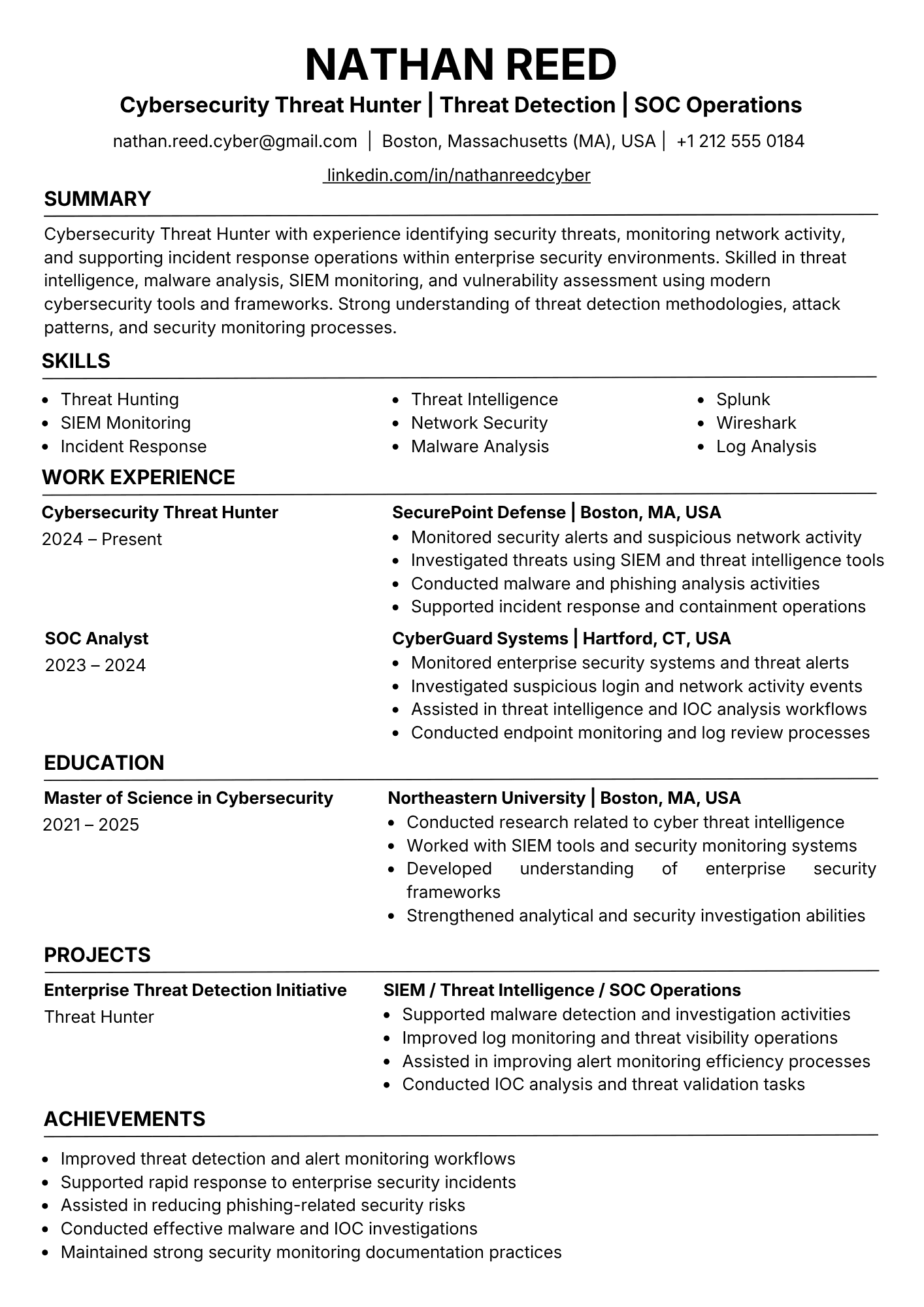
Cybersecurity Threat Hunter Resume Example & Sample
This preview uses a sample Cybersecurity Threat Hunter resume with minimal placeholder content to show single-column ATS layout and keyword placement. It is not a full work history—use it as a starting point only.
This is a sample resume with minimal placeholder content. Edit it to start building your real Cybersecurity Threat Hunter resume.
A clean, single-column layout designed to pass automated screeners and stay readable for recruiters.
ATS-friendly checklist
Three quick rules this template already follows.
- Keep one column so ATS parsers read headings and bullets top to bottom.
- Mirror keywords from the job description for tools, platforms, and outcomes.
- Run a free ATS scan on your resume before you submit.
Ready to build your winning Cybersecurity Threat Hunter resume?
Join thousands of Tech professionals bypassing ATS systems. Your expertly optimized Cybersecurity Threat Hunter resume is just a click away.

About the Author: Sreerag
Sreerag is a Career Tech Expert with over 10 years of experience in recruitment technology. He specializes in AI-driven CV optimization and has helped thousands of job seekers land roles at top companies worldwide.
Meet our experts