DevOps Release Manager Resume Example
DevOps Release Manager resumes must shift beyond Jenkins pipeline ownership and demonstrate deployment governance at scale — GitOps, SLI/SLO management, and release risk mitigation. Use a single-column ATS format with ArgoCD, Spinnaker, and DORA metrics keywords. NeuraCV positions your release engineering impact for 2026 hiring.
01Executive Professional Summary for DevOps Release Manager
Your professional summary is the first thing recruiters and hiring managers read. For DevOps Release Manager roles, it must immediately signal depth: years of experience, core focus, and at least one concrete outcome. Anchor your opening around role signals such as dora-driven release management, gitops and progressive delivery, change risk controls, reliability enablement. Keep it to 2–4 lines and include one measurable proof point (deployment-velocity impact, change-failure reduction, mttr impact, incident-risk reduction) so the summary works for both ATS matching and human scanning.
02Technical Philosophy & What Hiring Managers Value
Hiring managers in Tech care about impact, clarity, and evidence of ownership. DevOps release manager hiring in 2026 values leaders who can accelerate delivery while protecting system stability through disciplined governance. Frame your bullets around quantified outcomes, clear responsibility, and operational context so the reader can quickly understand your scope and reliability.
03Deep-Dive Core Competencies
Name the tools, frameworks, and methodologies you use. Mirror job-posting language so ATS systems and recruiters can map your profile quickly. For DevOps Release Manager, prioritize terms like dora-driven release management, gitops and progressive delivery, change risk controls, reliability enablement, then back each cluster with one short result-oriented example linked to deployment-velocity impact, change-failure reduction, mttr impact, incident-risk reduction.
04How to Structure Your Career Narrative on Your Resume
Use a reverse-chronological experience section. For each role, lead with scope and then 3–5 bullets in context-action-result format. Show progression over time and make sure each role demonstrates at least one concrete operational proof point (deployment-velocity impact, change-failure reduction, mttr impact, incident-risk reduction) tied to the realities of DevOps Release Manager.
05Featured Case Studies: Problem–Solution–Impact
Use a Projects or Key Projects section to highlight 2–3 major initiatives in a Problem-Solution-Impact format. Each entry should state the challenge, your approach, and a measurable outcome. For DevOps Release Manager, projects should reference role signals (dora-driven release management, gitops and progressive delivery, change risk controls, reliability enablement) and close with measurable impact (deployment-velocity impact, change-failure reduction, mttr impact, incident-risk reduction).
06Mentorship, Leadership & Continuous Learning
Mentorship, process ownership, and continuous learning show leadership and reliability. One concise bullet per role is enough, but it should be specific to Tech workflows and show contribution beyond task execution. Where relevant, include coaching, SOP improvements, or cross-team handoff standards.
07Continuous Learning & Certifications
Relevant certifications help with both ATS and recruiter screening. List certification names, validity, and recency, then connect them to real execution in your bullets. Keep this section tight (2–5 items) and prioritize credentials that reinforce role signals such as dora-driven release management, gitops and progressive delivery, change risk controls, reliability enablement.
08FAQ: Technical Expertise
Common recruiter questions include resume length, role-specific keyword coverage, and how to prove impact without inflated titles. Use the FAQ section below for detailed answers tailored to DevOps Release Manager hiring in 2026, with examples aligned to measurable proof points such as deployment-velocity impact, change-failure reduction, mttr impact, incident-risk reduction.
Core DevOps Release Manager Skills & Keyword Optimization
Use these keywords in your bullets and skills section. The example below shows how they appear in a real DevOps Release Manager resume.
Recommended Keywords for ATS
Top Skills in Example
What the Numbers Say About DevOps Release Manager Hiring
Why Do DevOps Release Manager Resumes Get Rejected by ATS?
If you are applying for DevOps Release Manager roles, your resume has to pass the ATS first. Here is what usually goes wrong:
Outdated sysadmin framing
Describing yourself as a pipeline maintainer or release coordinator positions you at the junior end. Reframe around deployment risk governance, change advisory board leadership, and release reliability ownership.
No DORA metrics or deployment frequency data
DORA metrics (deployment frequency, lead time for changes, MTTR, change failure rate) are the primary KPIs for release engineering roles. Resumes without these numbers fail ATS scoring and interviewer scrutiny.
Proprietary tools without open-source equivalents
Internal deployment tooling names mean nothing to ATS systems. Map them: 'Internal Deployment Orchestrator (comparable to Spinnaker / ArgoCD)'. This bridges the keyword gap without misrepresenting your experience.
No release-risk and incident-learning evidence
Senior release roles expect pre-release risk scoring, rollback decision quality, and post-incident learning loops. Add governance outcomes, not only deployment mechanics.
How NeuraCV Helps DevOps Release Managers Land More Interviews
NeuraCV shifts your resume focus from outdated deployment task descriptions to SLI/SLO governance and GitOps automation — the exact framing technical screeners prioritize in 2026 senior release roles.
The AI natively formats complex CI/CD pipeline structures so ATS systems correctly parse 'ArgoCD progressive delivery', 'Spinnaker canary analysis', and 'Blue/Green deployment' as distinct high-value competencies.
NeuraCV translates your deployment frequency improvements and MTTR reductions into business continuity language — bridging technical impact and enterprise value for both engineering and VP-level reviewers.
Role-specific prompts improve how you communicate change-governance ownership, release-readiness controls, and stakeholder confidence outcomes.
Guided phrasing helps link delivery velocity gains with reliability safeguards so your profile reads as senior release leadership.
The NeuraCredits Advantage
Stop paying $25/mo subscriptions.
Use NeuraCredits for a simple one-time payment. Pay only when you generate a winning resume. No hidden recurring fees. Only pay for what you use.
NeuraCV vs. Typical Resume Builders
| Feature | NeuraCV | Typical Builders |
|---|---|---|
| Role-Specific Keywords | Hyper-specific to DevOps Release Manager (e.g. exact tools & frameworks) | Generic categories only |
| Real-Time Job Tailoring | Dynamic contextual matching per JD | Static pre-written phrases |
| ATS Compatibility Check | Live scan with score | Not included |
| Pricing Model | Pay-per-use (NeuraCredits) | $25/mo subscription |
Role-Specific Keywords
- NeuraCV
- Hyper-specific to DevOps Release Manager (e.g. exact tools & frameworks)
- Typical Builders
- Generic categories only
Real-Time Job Tailoring
- NeuraCV
- Dynamic contextual matching per JD
- Typical Builders
- Static pre-written phrases
ATS Compatibility Check
- NeuraCV
- Live scan with score
- Typical Builders
- Not included
Pricing Model
- NeuraCV
- Pay-per-use (NeuraCredits)
- Typical Builders
- $25/mo subscription
Frequently Asked Questions: DevOps Release Manager Resume
What DORA metrics should I include on a DevOps Release Manager resume?
+
Include all four DORA metrics if you have the data: Deployment Frequency (e.g., 'Increased from bi-weekly to 15 deployments per day'), Lead Time for Changes (e.g., 'Reduced from 3 weeks to 2 hours'), MTTR — Mean Time to Restore (e.g., 'Reduced from 4 hours to 22 minutes'), and Change Failure Rate (e.g., 'Reduced rollback rate from 12% to 1.4%'). These metrics are the universal language of release engineering excellence.
How do I describe proprietary internal tools on my release manager resume?
+
Map proprietary tools to their open-source equivalents in parentheses: 'Internal Deployment Platform (comparable to Spinnaker/ArgoCD)', 'Internal Change Management System (built on ServiceNow)'. This ensures ATS keyword systems capture your capability level even when the exact tool name is not in their database. Also describe the specific capability you used, not just the tool name.
What CI/CD and GitOps tools are most important for Release Manager roles in 2026?
+
The most valued tools in 2026 Release Manager postings: ArgoCD (GitOps deployment), Spinnaker (canary/blue-green), GitHub Actions, Jenkins (legacy but still listed), Tekton, Flux CD, HashiCorp Vault (secret management), and Terraform (infrastructure as release). For change management: ServiceNow, Jira Service Management. Mention the specific deployment pattern each tool enabled (canary, rolling, blue-green).
How do I position Release Management experience for a broader DevOps leadership role?
+
Reframe release-specific achievements as platform-wide reliability improvements: change advisory board leadership → 'Reduced P1 incidents from release changes by 78% through risk-scored change gating', pipeline management → 'Enabled 20-team self-service release capability, reducing engineering dependency on platform team by 65%'. Position yourself as a multiplier for engineering velocity, not just a gatekeeper.
Is Release Management too niche for senior DevOps roles in 2026?
+
No — as organizations scale to hundreds of microservices, dedicated release governance becomes a critical function. The key is framing: emphasize 'deployment risk mitigation', 'platform reliability ownership', and 'GitOps governance' rather than 'running Jenkins pipelines'. Senior Release Managers who can demonstrate business continuity impact and developer experience improvements are highly valued at enterprise and high-growth companies.
Which metrics should I prioritize if I cannot share exact production numbers?
+
Use directional or percentage improvements with clear context: deployment frequency increase, lead-time reduction, rollback rate improvement, and MTTR trend. Example: 'Improved change-failure rate by 64% through canary gating and risk-tier approvals.' Relative metrics still show impact while respecting confidentiality constraints.
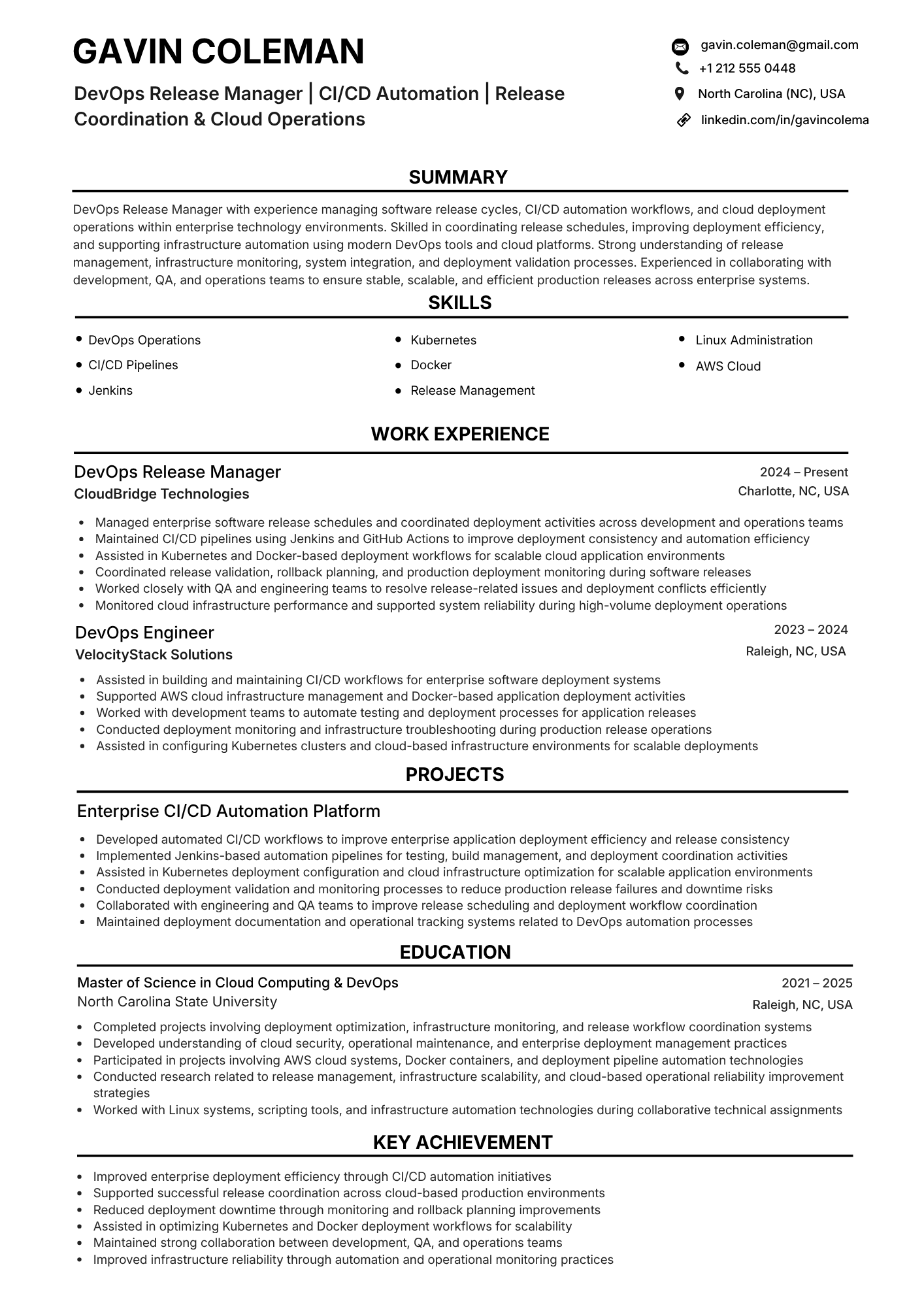
DevOps Release Manager resume example (ATS-ready)
This preview uses a sample DevOps Release Manager resume with minimal placeholder content to show single-column ATS layout and keyword placement. It is not a full work history—use it as a starting point only.
This is a sample resume with minimal placeholder content. Edit it to start building your real DevOps Release Manager resume.
A clean, single-column layout designed to pass automated screeners and stay readable for recruiters.
ATS-friendly checklist
Three quick rules this template already follows.
- Keep one column so ATS parsers read headings and bullets top to bottom.
- Mirror keywords from the job description for tools, platforms, and outcomes.
- Run a free ATS scan on your resume before you submit.
Ready to build your winning DevOps Release Manager resume?
Join thousands of Tech professionals bypassing ATS systems. Your expertly optimized DevOps Release Manager resume is just a click away.

About the Author: Sreerag
Sreerag is a Career Tech Expert with over 10 years of experience in recruitment technology. He specializes in AI-driven CV optimization and has helped thousands of job seekers land roles at top companies worldwide.
Meet our experts