Surgical Robotics Technician Resume Example
Surgical Robotics Technician resumes must prove da Vinci proctoring completion, system error troubleshooting under OR conditions, and sterile instrument management for robotic-assisted procedures — not just general biomedical technician experience. Use a single-column ATS format with da Vinci, robotic instrument processing, and OR integration keywords. NeuraCV formats your specialized robotics credentials for 2026.
01Executive Professional Summary for Surgical Robotics Technician
Your professional summary is the first thing recruiters and hiring managers read. For Surgical Robotics Technician roles, it must immediately signal depth: years of experience, core focus, and at least one concrete outcome. Anchor your opening around role signals such as platform certification depth, fault response workflows, instrument lifecycle control, or throughput support. Keep it to 2–4 lines and include one measurable proof point (delay-reduction impact, fault-resolution impact, instrument-readiness impact, uptime/continuity impact) so the summary works for both ATS matching and human scanning.
02Technical Philosophy & What Hiring Managers Value
Hiring managers in Healthcare care about impact, clarity, and evidence of ownership. Surgical robotics hiring in 2026 favors technicians who can combine sterile precision, platform reliability, and high-pressure OR troubleshooting consistency. Frame your bullets around quantified outcomes, clear responsibility, and operational context so the reader can quickly understand your scope and reliability.
03Deep-Dive Core Competencies
Name the tools, frameworks, and methodologies you use. Mirror job-posting language so ATS systems and recruiters can map your profile quickly. For Surgical Robotics Technician, prioritize terms like platform certification depth, fault response workflows, instrument lifecycle control, or throughput support, then back each cluster with one short result-oriented example linked to delay-reduction impact, fault-resolution impact, instrument-readiness impact, uptime/continuity impact.
04How to Structure Your Career Narrative on Your Resume
Use a reverse-chronological experience section. For each role, lead with scope and then 3–5 bullets in context-action-result format. Show progression over time and make sure each role demonstrates at least one concrete operational proof point (delay-reduction impact, fault-resolution impact, instrument-readiness impact, uptime/continuity impact) tied to the realities of Surgical Robotics Technician.
05Featured Case Studies: Problem–Solution–Impact
Use a Projects or Key Projects section to highlight 2–3 major initiatives in a Problem-Solution-Impact format. Each entry should state the challenge, your approach, and a measurable outcome. For Surgical Robotics Technician, projects should reference role signals (platform certification depth, fault response workflows, instrument lifecycle control, or throughput support) and close with measurable impact (delay-reduction impact, fault-resolution impact, instrument-readiness impact, uptime/continuity impact).
06Mentorship, Leadership & Continuous Learning
Mentorship, process ownership, and continuous learning show leadership and reliability. One concise bullet per role is enough, but it should be specific to Healthcare workflows and show contribution beyond task execution. Where relevant, include coaching, SOP improvements, or cross-team handoff standards.
07Continuous Learning & Certifications
Relevant certifications help with both ATS and recruiter screening. List certification names, validity, and recency, then connect them to real execution in your bullets. Keep this section tight (2–5 items) and prioritize credentials that reinforce role signals such as platform certification depth, fault response workflows, instrument lifecycle control, or throughput support.
08FAQ: Technical Expertise
Common recruiter questions include resume length, role-specific keyword coverage, and how to prove impact without inflated titles. Use the FAQ section below for detailed answers tailored to Surgical Robotics Technician hiring in 2026, with examples aligned to measurable proof points such as delay-reduction impact, fault-resolution impact, instrument-readiness impact, uptime/continuity impact.
Core Surgical Robotics Technician Skills & Keyword Optimization
Use these keywords in your bullets and skills section. The example below shows how they appear in a real Surgical Robotics Technician resume.
Recommended Keywords for ATS
Top Skills in Example
What the Numbers Say About Surgical Robotics Technician Hiring
Why Do Surgical Robotics Technician Resumes Get Rejected by ATS?
If you are applying for Surgical Robotics Technician roles, your resume has to pass the ATS first. Here is what usually goes wrong:
General CST credentials without robotic system specifics
Certified Surgical Technologist experience without da Vinci, Stryker Mako, or Medtronic Hugo specifics fails ATS at robotic surgery programs. Name every system you are trained on and your certification level.
No proctoring or training completion specifics
Intuitive Surgical da Vinci proctoring and system-specific training are ATS keyword requirements. Not listing your da Vinci proctoring status (initial, advanced), Si/Xi/SP platform experience, or case count signals insufficient depth.
Missing OR troubleshooting and system error management experience
Surgical robotics techs are the first responders when systems malfunction in the OR. Not describing your fault diagnosis, system restart protocols, and escalation procedures under sterile conditions signals limited operational experience.
No instrument lifecycle and uptime reliability outcomes
Senior robotics tech roles expect measurable reduction in case delays, instrument failures, and platform downtime through preventive controls.
How NeuraCV Helps Surgical Robotics Technicians Land More Interviews
NeuraCV identifies the exact surgical robotics terminology — da Vinci Xi proctoring, EndoWrist instrument processing, and intraoperative fault management — that robotic surgery program ATS systems prioritize in 2026.
The AI formats your system-specific training certifications, OR integration experience, and case volume metrics as distinct, ATS-scannable credentials that general biomedical technician resumes cannot match.
NeuraCV ensures your sterile instrument management and SPD coordination experience is framed with the patient safety and surgical efficiency language that OR Directors and Robotic Surgery Program Coordinators look for.
Role-specific prompts improve how you present OR readiness, troubleshooting reliability, and escalation governance outcomes.
Guided phrasing helps connect robotic-system operations to patient safety and throughput consistency.
The NeuraCredits Advantage
Stop paying $25/mo subscriptions.
Use NeuraCredits for a simple one-time payment. Pay only when you generate a winning resume. No hidden recurring fees. Only pay for what you use.
NeuraCV vs. Typical Resume Builders
| Feature | NeuraCV | Typical Builders |
|---|---|---|
| Role-Specific Keywords | Hyper-specific to Surgical Robotics Technician (e.g. exact tools & frameworks) | Generic categories only |
| Real-Time Job Tailoring | Dynamic contextual matching per JD | Static pre-written phrases |
| ATS Compatibility Check | Live scan with score | Not included |
| Pricing Model | Pay-per-use (NeuraCredits) | $25/mo subscription |
Role-Specific Keywords
- NeuraCV
- Hyper-specific to Surgical Robotics Technician (e.g. exact tools & frameworks)
- Typical Builders
- Generic categories only
Real-Time Job Tailoring
- NeuraCV
- Dynamic contextual matching per JD
- Typical Builders
- Static pre-written phrases
ATS Compatibility Check
- NeuraCV
- Live scan with score
- Typical Builders
- Not included
Pricing Model
- NeuraCV
- Pay-per-use (NeuraCredits)
- Typical Builders
- $25/mo subscription
Frequently Asked Questions: Surgical Robotics Technician Resume
What da Vinci certifications should I list on a Surgical Robotics Technician resume?
+
List every Intuitive Surgical training completion with platform and level: da Vinci Xi Bedside Technician Certification, da Vinci SP (Single Port) System Training, da Vinci Simulation Training (Mimic dV-Trainer), and any advanced instrument certification. If you have completed initial proctor cases: 'da Vinci Xi — 12 initial proctor cases completed, urology and gynecology specialties.' Also list Stryker Mako SmartRobotics training for orthopedic robotic programs, and any Medtronic Hugo or CMR Versius training for emerging platform experience.
How do I show OR troubleshooting experience on my robotic technician resume?
+
Describe your fault management in operational context: 'Managed 23 intraoperative system faults on da Vinci Xi over 2-year period — performed real-time diagnosis and resolution including arm collision recovery, sterile barrier breach protocols, and energy system fault correction, maintaining OR sterility and case continuation in 91% of incidents.' Include your escalation protocols, communication with Intuitive Field Service, and documentation procedures for system events.
What robotic systems experience is most valued for technician roles in 2026?
+
The most ATS-relevant systems in 2026: Intuitive Surgical da Vinci (Xi, Si, SP — specify all platforms), Stryker Mako SmartRobotics (TKA and THA applications), Medtronic Hugo RAS System, CMR Surgical Versius, and Zimmer Biomet ROSA (spine and knee). For specialty programs: Accuray CyberKnife/TomoTherapy for radiosurgery, Mazor X Stealth for spine, and ROSA Brain for neurosurgery. List the specific surgical specialties you support (urology, gynecology, colorectal, cardiac, orthopedic) alongside each system.
How do I show sterile instrument management experience for robotic procedures?
+
Describe the robotic-specific instrument handling with volume and accuracy: 'Managed EndoWrist instrument inventory of 85 instruments for 4-room robotic surgery program — conducted pre/post-operative inspection of all instruments for damage assessment, coordinated SPD workflow for robotic-specific reprocessing per Intuitive instructions for use (IFU), achieved 0 instrument-related case delays over 18-month audit period.' Include your da Vinci instrument use life tracking (number of uses per instrument), procurement coordination, and any loaner instrument management.
What CST or BioMed certifications complement robotic technician credentials?
+
The strongest credential combinations: CST (Certified Surgical Technologist) — NBSTSA credential is the baseline for OR technicians. CRCST (Certified Registered Central Service Technician) — IAHCSMM credential for SPD/sterile processing expertise. CBET (Certified Biomedical Equipment Technician) for the technical/electronic troubleshooting aspect. Intuitive Surgical platform-specific certifications (listed above). For career advancement: CNOR (Certified Perioperative Nurse) if you hold RN credentials, or Robotic Surgery Program Coordinator certification offered by AAGL.
How should I show reliability and downtime impact in robotic surgery support?
+
Include case-delay reduction, fault-resolution success, and instrument readiness metrics. Example: 'Reduced robotics-related OR delays by 52% through pre-case readiness protocols and maintained 97% first-response fault resolution during intraoperative events.'
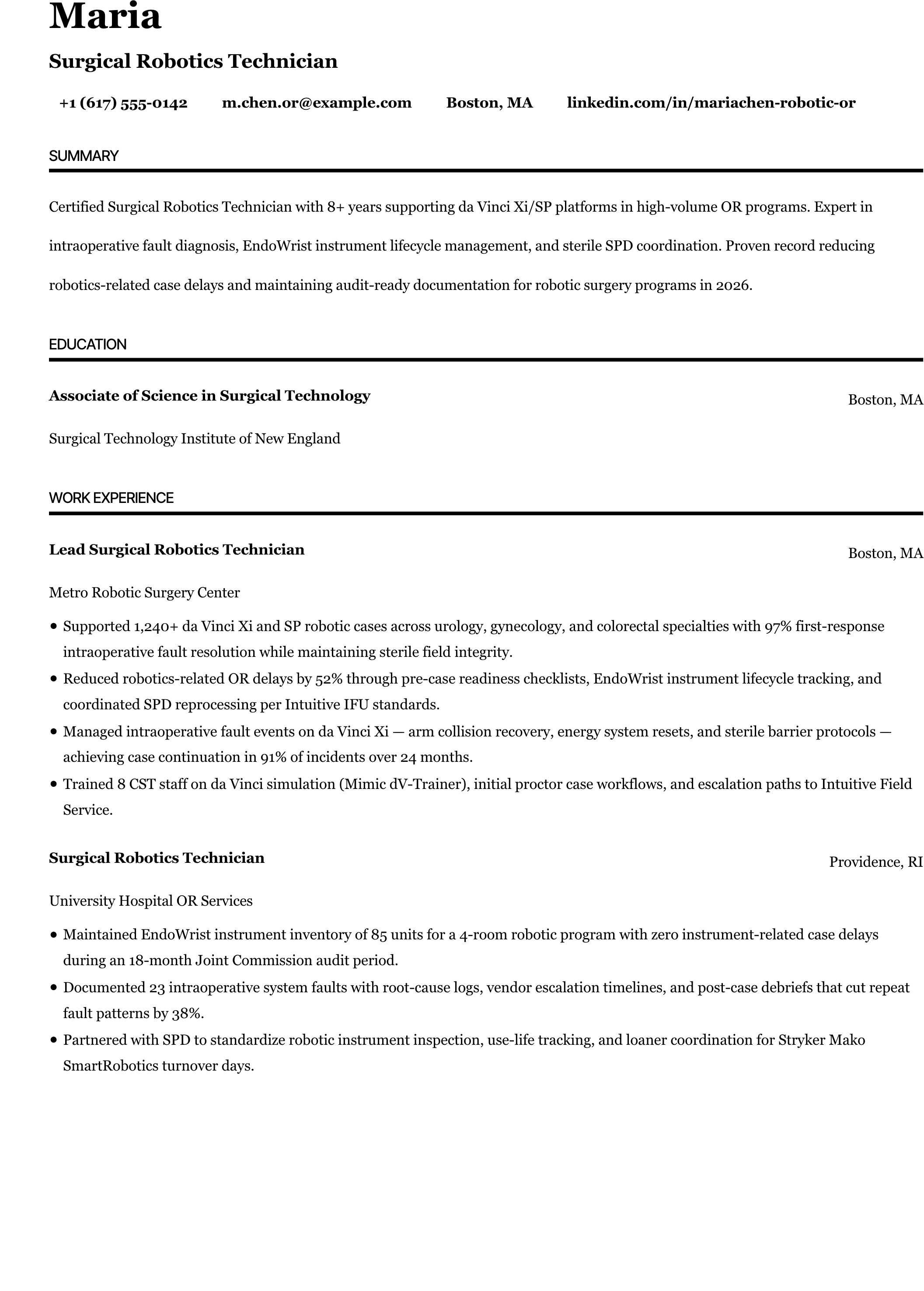
Surgical Robotics Technician resume example (ATS-ready)
Preview a single-column layout with da Vinci platform keywords, CST credentials, and OR troubleshooting bullets—formatted for 2026 robotic surgery program ATS filters.
This is a sample resume with minimal placeholder content. Edit it to start building your real Surgical Robotics Technician resume.
A clean, single-column layout designed to pass automated screeners and stay readable for recruiters.
ATS-friendly checklist
Three quick rules this template already follows.
- Keep one column so ATS parsers read headings and bullets top to bottom.
- Mirror keywords from the job description for tools, platforms, and outcomes.
- Run a free ATS scan on your resume before you submit.
Ready to build your winning Surgical Robotics Technician resume?
Join thousands of Healthcare professionals bypassing ATS systems. Your expertly optimized Surgical Robotics Technician resume is just a click away.

About the Author: Sreerag
Sreerag is a Career Tech Expert with over 10 years of experience in recruitment technology. He specializes in AI-driven CV optimization and has helped thousands of job seekers land roles at top companies worldwide.
Meet our experts