AR/VR Interaction Designer Resume Guide
AR/VR Interaction Designer resumes must go beyond screen-based UX and demonstrate spatial computing fluency — gaze-based interactions, haptic feedback, and comfort optimization. Use a portfolio-linked ATS format with Unity, Unreal Engine, and spatial audio keywords. NeuraCV helps you translate immersive experience into 2026 ATS-ready language.
01Executive Professional Summary for AR/VR Interaction Designer
Your professional summary is the first thing recruiters and hiring managers read. For AR/VR Interaction Designer roles, it must immediately signal depth: years of experience, core focus, and at least one concrete outcome. Anchor your opening around role signals such as spatial interaction patterns, immersive SDK fluency, comfort and accessibility controls, portfolio-backed execution. Keep it to 2–4 lines and include one measurable proof point (comfort-score impact, interaction-success impact, performance impact, retention or engagement impact) so the summary works for both ATS matching and human scanning.
02Technical Philosophy & What Hiring Managers Value
Hiring managers in Tech care about impact, clarity, and evidence of ownership. AR/VR interaction designer hiring in 2026 favors candidates who combine spatial design craft, comfort-first thinking, and measurable product outcomes. Frame your bullets around quantified outcomes, clear responsibility, and operational context so the reader can quickly understand your scope and reliability.
03Deep-Dive Core Competencies
Name the tools, frameworks, and methodologies you use. Mirror job-posting language so ATS systems and recruiters can map your profile quickly. For AR/VR Interaction Designer, prioritize terms like spatial interaction patterns, immersive SDK fluency, comfort and accessibility controls, portfolio-backed execution, then back each cluster with one short result-oriented example linked to comfort-score impact, interaction-success impact, performance impact, retention or engagement impact.
04How to Structure Your Career Narrative on Your Resume
Use a reverse-chronological experience section. For each role, lead with scope and then 3–5 bullets in context-action-result format. Show progression over time and make sure each role demonstrates at least one concrete operational proof point (comfort-score impact, interaction-success impact, performance impact, retention or engagement impact) tied to the realities of AR/VR Interaction Designer.
05Featured Case Studies: Problem–Solution–Impact
Use a Projects or Key Projects section to highlight 2–3 major initiatives in a Problem-Solution-Impact format. Each entry should state the challenge, your approach, and a measurable outcome. For AR/VR Interaction Designer, projects should reference role signals (spatial interaction patterns, immersive SDK fluency, comfort and accessibility controls, portfolio-backed execution) and close with measurable impact (comfort-score impact, interaction-success impact, performance impact, retention or engagement impact).
06Mentorship, Leadership & Continuous Learning
Mentorship, process ownership, and continuous learning show leadership and reliability. One concise bullet per role is enough, but it should be specific to Tech workflows and show contribution beyond task execution. Where relevant, include coaching, SOP improvements, or cross-team handoff standards.
07Continuous Learning & Certifications
Relevant certifications help with both ATS and recruiter screening. List certification names, validity, and recency, then connect them to real execution in your bullets. Keep this section tight (2–5 items) and prioritize credentials that reinforce role signals such as spatial interaction patterns, immersive SDK fluency, comfort and accessibility controls, portfolio-backed execution.
08FAQ: Technical Expertise
Common recruiter questions include resume length, role-specific keyword coverage, and how to prove impact without inflated titles. Use the FAQ section below for detailed answers tailored to AR/VR Interaction Designer hiring in 2026, with examples aligned to measurable proof points such as comfort-score impact, interaction-success impact, performance impact, retention or engagement impact.
Core AR/VR Interaction Designer Skills & Keyword Optimization
Use these keywords in your bullets and skills section. The example below shows how they appear in a real AR/VR Interaction Designer resume.
Recommended Keywords for ATS
Top Skills in Example
What the Numbers Say About AR/VR Interaction Designer Hiring
Why Do AR/VR Interaction Designer Resumes Get Rejected by ATS?
If you are applying for AR/VR Interaction Designer roles, your resume has to pass the ATS first. Here is what usually goes wrong:
Portfolio link is missing or broken
ATS systems cannot evaluate design work, but recruiters immediately check. Ensure your resume contains a clean, always-live URL to interactive demos — not static screenshots.
No platform or SDK specifics
Saying 'worked in VR' is invisible to ATS. Name the exact SDKs: ARKit, ARCore, OpenXR, WebXR, Oculus SDK, or SteamVR. Include device targets: Quest 3, Vision Pro, HoloLens 2.
Comfort and accessibility metrics absent
Senior AR/VR roles prioritize reducing simulator sickness and building accessible interactions. Include comfort rating improvements, vection reduction techniques, or accessibility accommodations you designed.
No interaction-performance evidence
Immersive UX work should include frame-rate targets, interaction-latency improvements, and stability constraints to prove practical design execution.
How NeuraCV Helps AR/VR Interaction Designers Land More Interviews
NeuraCV identifies the exact spatial UX terminology — gaze dwell time, spatial audio occlusion, haptic response mapping — that 2026 AR/VR hiring managers search for and ATS systems score against.
The AI reformats your Unity and Unreal prototyping project history into quantified impact bullets: frame rate targets met, interaction latency reduced, user comfort scores improved.
NeuraCV's ATS check validates that your portfolio URL and GitHub links are formatted as ATS-readable plain text, so they survive PDF-to-text parsing without breaking.
Role-specific prompts help you present immersive UX decisions with measurable usability, comfort, and engagement outcomes.
Guided phrasing improves how you communicate cross-functional execution between design, 3D art, and engineering constraints.
The NeuraCredits Advantage
Stop paying $25/mo subscriptions.
Use NeuraCredits for a simple one-time payment. Pay only when you generate a winning resume. No hidden recurring fees. Only pay for what you use.
NeuraCV vs. Typical Resume Builders
| Feature | NeuraCV | Typical Builders |
|---|---|---|
| Role-Specific Keywords | Hyper-specific to AR/VR Interaction Designer (e.g. exact tools & frameworks) | Generic categories only |
| Real-Time Job Tailoring | Dynamic contextual matching per JD | Static pre-written phrases |
| ATS Compatibility Check | Live scan with score | Not included |
| Pricing Model | Pay-per-use (NeuraCredits) | $25/mo subscription |
Role-Specific Keywords
- NeuraCV
- Hyper-specific to AR/VR Interaction Designer (e.g. exact tools & frameworks)
- Typical Builders
- Generic categories only
Real-Time Job Tailoring
- NeuraCV
- Dynamic contextual matching per JD
- Typical Builders
- Static pre-written phrases
ATS Compatibility Check
- NeuraCV
- Live scan with score
- Typical Builders
- Not included
Pricing Model
- NeuraCV
- Pay-per-use (NeuraCredits)
- Typical Builders
- $25/mo subscription
Frequently Asked Questions: AR/VR Interaction Designer Resume
Should I include my portfolio link on an AR/VR resume, and where?
+
Yes — put it in the header next to your email and LinkedIn, not buried in a projects section. Format it as plain text (e.g., portfolio.yourname.com) so ATS parsers can read it. Include a second link in each relevant project bullet using the format: '[Project Name] — yourdomain.com/project'. Make sure every link resolves to a live page with video walkthroughs, not just static images.
What distinguishes a junior AR/VR designer from a senior one on a resume?
+
Senior designers demonstrate: motion comfort optimization (reducing vomit coefficient through locomotion design), accessibility compliance for users with vestibular disorders, multi-platform SDK expertise, and cross-functional collaboration with 3D artists, audio engineers, and hardware teams. Quantify comfort ratings, retention metrics from immersive experiences, and the scale of projects (users, sessions, or commercial deployment).
Which AR/VR tools and SDKs should I list for 2026 job applications?
+
The most ATS-relevant tools in 2026 are: Unity (XR Interaction Toolkit), Unreal Engine (VR Template, MetaXR), ARKit, ARCore, OpenXR, WebXR, Oculus/Meta SDK, SteamVR, Vuforia, and Niantic Lightship. For design tools: Gravity Sketch, ShapesXR, Figma (for 2D flows), and SparkAR. List the specific version or generation if relevant (e.g., 'Meta SDK v63+').
How do I show UX research skills specific to immersive environments?
+
Describe your research methods in spatial context: 'Conducted 12 immersive usability sessions using think-aloud protocol with biometric comfort monitoring, identifying 4 high-friction interaction points that increased task completion by 23%.' Mention eye-tracking analysis, presence questionnaires (IPQ, SUS adapted for VR), and any A/B testing across locomotion methods.
Is it worth getting certified in AR/VR design for resume purposes?
+
Unity Certified Professional and Meta Certified Spatial Computing Developer are the two most recognized credentials in 2026. Apple Foundations certification (for Vision Pro development) is gaining traction. These certifications are ATS-scannable and signal commitment to platform-specific expertise. List them in a dedicated Certifications section rather than embedding in Skills.
What metrics are most valuable for AR/VR interaction design resumes?
+
Use interaction-completion rates, comfort score movement, frame stability, latency improvements, and retention impacts from immersive flows. Example: 'Reduced onboarding interaction failures by 27% while maintaining 90fps target on Quest hardware through redesigned gesture affordances.'
AR/VR Interaction Designer Resume Example & Sample
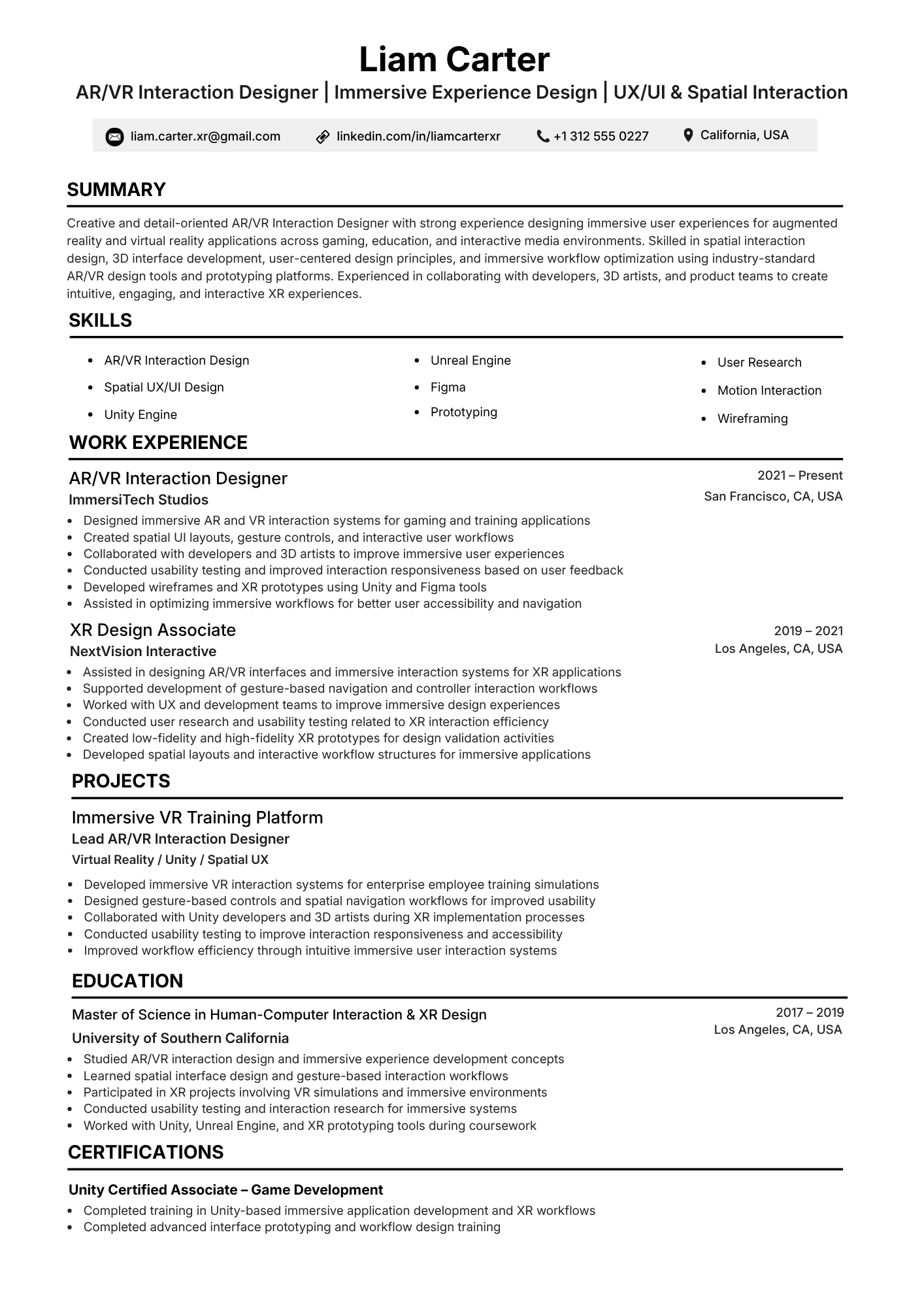
This preview uses a sample AR/VR Interaction Designer resume with minimal placeholder content to show single-column ATS layout and keyword placement. It is not a full work history—use it as a starting point only.
This is a sample resume with minimal placeholder content. Edit it to start building your real AR/VR Interaction Designer resume.
A clean, single-column layout designed to pass automated screeners and stay readable for recruiters.
ATS-friendly checklist
Three quick rules this template already follows.
- Keep one column so ATS parsers read headings and bullets top to bottom.
- Mirror keywords from the job description for tools, platforms, and outcomes.
- Run a free ATS scan on your resume before you submit.
Ready to build your winning AR/VR Interaction Designer resume?
Join thousands of Tech professionals bypassing ATS systems. Your expertly optimized AR/VR Interaction Designer resume is just a click away.

About the Author: Sreerag
Sreerag is a Career Tech Expert with over 10 years of experience in recruitment technology. He specializes in AI-driven CV optimization and has helped thousands of job seekers land roles at top companies worldwide.
Meet our experts