Game AI Programmer Resume Guide
Game AI Programmer resumes must demonstrate frame-budget-aware AI systems, behavior tree and GOAP architecture, and — increasingly in 2026 — generative AI integration for dynamic NPC dialogue. Use a performance-focused ATS format with Unreal Engine, behavior trees, and ONNX Runtime keywords. NeuraCV formats your game systems expertise for AAA and indie AI roles.
01Executive Professional Summary for Game AI Programmer
Your professional summary is the first thing recruiters and hiring managers read. For Game AI Programmer roles, it must immediately signal depth: years of experience, core focus, and at least one concrete outcome. Anchor your opening around role signals such as behavior architecture, frame-budget optimization, engine-specific ai systems, generative npc workflows. Keep it to 2–4 lines and include one measurable proof point (performance impact, stability impact, player-experience impact, live-ops quality impact) so the summary works for both ATS matching and human scanning.
02Technical Philosophy & What Hiring Managers Value
Hiring managers in Tech care about impact, clarity, and evidence of ownership. Game AI hiring in 2026 rewards programmers who can ship performant, robust, and engaging AI systems under real production constraints. Frame your bullets around quantified outcomes, clear responsibility, and operational context so the reader can quickly understand your scope and reliability.
03Deep-Dive Core Competencies
Name the tools, frameworks, and methodologies you use. Mirror job-posting language so ATS systems and recruiters can map your profile quickly. For Game AI Programmer, prioritize terms like behavior architecture, frame-budget optimization, engine-specific ai systems, generative npc workflows, then back each cluster with one short result-oriented example linked to performance impact, stability impact, player-experience impact, live-ops quality impact.
04How to Structure Your Career Narrative on Your Resume
Use a reverse-chronological experience section. For each role, lead with scope and then 3–5 bullets in context-action-result format. Show progression over time and make sure each role demonstrates at least one concrete operational proof point (performance impact, stability impact, player-experience impact, live-ops quality impact) tied to the realities of Game AI Programmer.
05Featured Case Studies: Problem–Solution–Impact
Use a Projects or Key Projects section to highlight 2–3 major initiatives in a Problem-Solution-Impact format. Each entry should state the challenge, your approach, and a measurable outcome. For Game AI Programmer, projects should reference role signals (behavior architecture, frame-budget optimization, engine-specific ai systems, generative npc workflows) and close with measurable impact (performance impact, stability impact, player-experience impact, live-ops quality impact).
06Mentorship, Leadership & Continuous Learning
Mentorship, process ownership, and continuous learning show leadership and reliability. One concise bullet per role is enough, but it should be specific to Tech workflows and show contribution beyond task execution. Where relevant, include coaching, SOP improvements, or cross-team handoff standards.
07Continuous Learning & Certifications
Relevant certifications help with both ATS and recruiter screening. List certification names, validity, and recency, then connect them to real execution in your bullets. Keep this section tight (2–5 items) and prioritize credentials that reinforce role signals such as behavior architecture, frame-budget optimization, engine-specific ai systems, generative npc workflows.
08FAQ: Technical Expertise
Common recruiter questions include resume length, role-specific keyword coverage, and how to prove impact without inflated titles. Use the FAQ section below for detailed answers tailored to Game AI Programmer hiring in 2026, with examples aligned to measurable proof points such as performance impact, stability impact, player-experience impact, live-ops quality impact.
Core Game AI Programmer Skills & Keyword Optimization
Use these keywords in your bullets and skills section. The example below shows how they appear in a real Game AI Programmer resume.
Recommended Keywords for ATS
Top Skills in Example
What the Numbers Say About Game AI Programmer Hiring
Why Do Game AI Programmer Resumes Get Rejected by ATS?
If you are applying for Game AI Programmer roles, your resume has to pass the ATS first. Here is what usually goes wrong:
No frame budget or performance metrics
Game AI is real-time. Resumes that do not specify per-frame CPU budgets maintained, concurrent agent counts, or memory footprints fail to demonstrate production-level awareness for console and PC targets.
Missing AI architecture specifics
Listing 'game AI' without naming the architecture is invisible to ATS. Include behavior trees, GOAP (Goal-Oriented Action Planning), Utility AI, NavMesh, and Hierarchical Task Networks — the specific systems you built.
No generative AI or LLM integration experience
In 2026, generative AI for dynamic NPC dialogue, procedural quest generation, and reactive behavior is a fast-growing requirement. Not mentioning LLM integration (ONNX, local models, API-based) positions you behind the curve.
No gameplay safety and fail-state controls
Senior game AI roles expect graceful fallback behavior, exploit prevention, and predictable agent behavior under edge cases. Include reliability controls, not just features.
How NeuraCV Helps Game AI Programmers Land More Interviews
NeuraCV highlights your behavior tree, GOAP, and pathfinding expertise in the precise language AAA studios and middleware companies use in 2026 game AI job postings.
The AI formats your multi-platform performance profiling experience — CPU/GPU frame budgets, memory optimization across PS5/Xbox/PC — as distinct ATS-scannable competencies.
NeuraCV surfaces the generative AI and LLM integration keywords increasingly required for cutting-edge NPC systems, positioning you for next-generation game AI roles.
Role-specific prompts improve how you present shipped-system reliability, edge-case handling, and QA-collaboration outcomes.
Guided phrasing helps connect AI architecture choices to player experience, performance consistency, and live-ops stability.
The NeuraCredits Advantage
Stop paying $25/mo subscriptions.
Use NeuraCredits for a simple one-time payment. Pay only when you generate a winning resume. No hidden recurring fees. Only pay for what you use.
NeuraCV vs. Typical Resume Builders
| Feature | NeuraCV | Typical Builders |
|---|---|---|
| Role-Specific Keywords | Hyper-specific to Game AI Programmer (e.g. exact tools & frameworks) | Generic categories only |
| Real-Time Job Tailoring | Dynamic contextual matching per JD | Static pre-written phrases |
| ATS Compatibility Check | Live scan with score | Not included |
| Pricing Model | Pay-per-use (NeuraCredits) | $25/mo subscription |
Role-Specific Keywords
- NeuraCV
- Hyper-specific to Game AI Programmer (e.g. exact tools & frameworks)
- Typical Builders
- Generic categories only
Real-Time Job Tailoring
- NeuraCV
- Dynamic contextual matching per JD
- Typical Builders
- Static pre-written phrases
ATS Compatibility Check
- NeuraCV
- Live scan with score
- Typical Builders
- Not included
Pricing Model
- NeuraCV
- Pay-per-use (NeuraCredits)
- Typical Builders
- $25/mo subscription
Frequently Asked Questions: Game AI Programmer Resume
How do I quantify game AI performance on a resume?
+
Use the three core metrics of real-time AI performance: CPU budget (e.g., 'Maintained 0.8ms per-frame AI budget for 200 concurrent NPCs on PS5'), concurrent agent scale (e.g., 'Designed LOD-aware behavior tree system supporting 500+ background agents at 60fps'), and memory footprint (e.g., 'Reduced NavMesh memory from 48MB to 12MB through dynamic tile loading'). These numbers resonate immediately with technical hiring managers at studios.
What is the 2026 trend for Game AI Programmers and how do I show it?
+
The defining trend is generative AI integration — using LLMs and diffusion models for dynamic NPC dialogue, procedural narrative, and context-aware behavior. Show this explicitly: 'Integrated local ONNX Runtime model for procedural NPC dialogue generation, producing context-aware responses without network latency' or 'Built RAG-based NPC memory system using LangChain, enabling NPCs to reference 30-day player history in dialogue.' This separates 2026 candidates from those still describing finite state machines.
Should I list game engine version numbers on my resume?
+
Yes for major version transitions. Specifying 'Unreal Engine 5 (Nanite, Lumen, Mass Entity)' or 'Unity 6 (DOTS, Entity Component System)' signals your knowledge of modern engine architectures that are relevant to AI systems (especially ECS-based AI at scale). Version-specific knowledge demonstrates that you are current and not relying on decade-old engine patterns.
How do I show my contribution to shipped games on a resume?
+
Include game title, platform, metacritic score or sales figure if public, your specific AI system ownership, and a measurable outcome: 'Shipped 'GameTitle' (PS5/Xbox, 4.2M units sold) — sole owner of companion AI system using GOAP with dynamic goal weighting, achieving 94% player satisfaction rating in post-launch surveys.' If NDA prevents naming the title, use 'AAA Action RPG (unannounced)' and still include your system ownership and metrics.
What programming languages are most important for Game AI Programmers in 2026?
+
C++ remains the primary language for performance-critical game AI systems at AAA studios — proficiency with modern C++20/23 features (coroutines for behavior trees, compile-time reflection) is expected. C# is required for Unity projects. Python is increasingly used for AI tooling, testing harnesses, and LLM integration pipelines. Blueprint visual scripting knowledge is helpful for Unreal roles. List your proficiency level and context for each.
What extra metrics should I include besides frame-time budget?
+
Add behavior success rate, AI bug regression reduction, pathfinding stability, and player engagement impact where available. Example: 'Reduced AI-related gameplay blockers by 46% and increased NPC interaction completion rate by 19% after redesigning behavior-priority scheduling under heavy combat loads.'
Game AI Programmer Resume Example & Sample
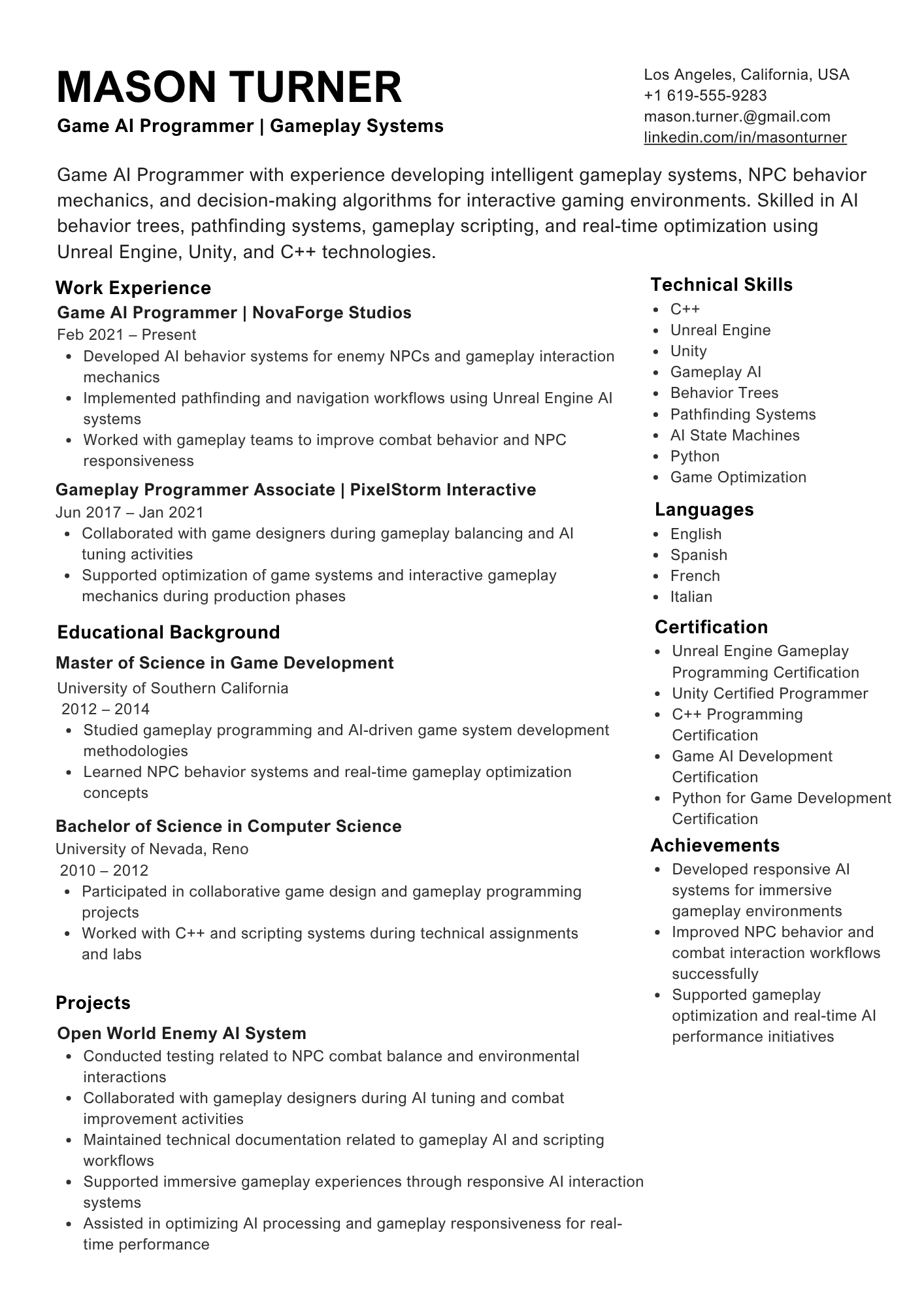
This preview uses a sample Game AI Programmer resume with minimal placeholder content to show single-column ATS layout and keyword placement. It is not a full work history—use it as a starting point only.
This is a sample resume with minimal placeholder content. Edit it to start building your real Game AI Programmer resume.
A clean, single-column layout designed to pass automated screeners and stay readable for recruiters.
ATS-friendly checklist
Three quick rules this template already follows.
- Keep one column so ATS parsers read headings and bullets top to bottom.
- Mirror keywords from the job description for tools, platforms, and outcomes.
- Run a free ATS scan on your resume before you submit.
Ready to build your winning Game AI Programmer resume?
Join thousands of Tech professionals bypassing ATS systems. Your expertly optimized Game AI Programmer resume is just a click away.

About the Author: Sreerag
Sreerag is a Career Tech Expert with over 10 years of experience in recruitment technology. He specializes in AI-driven CV optimization and has helped thousands of job seekers land roles at top companies worldwide.
Meet our experts